What's the ideal desk height for your body?
Most desks are built to one fixed height, but bodies aren't. Here's how to work out the height that actually fits you — sitting and standing — and what to do when the desk you own won't budge.
At a glance
| Product | Best for | Price | Warranty |
|---|---|---|---|
| ErgoPro Mesh Office Chair | Breathable mesh, full adjust | € 249.95 | 2 years |
| Lite Ergonomic Task Chair | Compact, supportive | € 159.95 | 2 years |
| Base Footrest | Tilting, non-slip top | € 34.95 | 2 years |
| Zenith Monitor Riser | Bamboo shelf, cable slot | € 59.95 | 2 years |
| Lift Adjustable Riser | 3 stacking heights | € 44.95 | 2 years |
| Apex Electric Standing Desk | Dual-motor, memory presets | € 399.95 | 2 years |
| Pillar Sit-Stand Frame | Add your own top | € 279.95 | 2 years |
| Rise Standing Desk Converter | Sit-stand, two-tier | € 189.95 | 2 years |
| Terra Anti-Fatigue Mat | Cushioned, bevelled edge | € 54.95 | 2 years |
| Arc Single Monitor Arm | Gas-spring, full motion | € 79.95 | 2 years |
The only rule that really matters: elbow height
Forget the numbers printed on the box for a moment. The single measurement that decides whether a desk fits you is your seated elbow height. Sit tall with your feet flat on the floor and your upper arms hanging straight down from relaxed shoulders. Now bend your elbows so your forearms are roughly parallel to the floor — a little over 90 degrees is fine. The height of your elbows in that position is where the top of your keyboard should sit. Not the desk surface exactly, but the keys your fingers rest on. Why elbows and not, say, the desktop? Because your forearms are the part doing the work all day, and keeping them level keeps your wrists neutral and your shoulders down. When a surface is too high, your shoulders creep up toward your ears and stay there — a slow, low-grade tension you often only notice as an ache at 4pm. Too low, and you round forward and hunch to reach it. The elbow rule cuts through every marketing spec and tells you directly whether a given height works for your frame.
Why 'standard' desk height fails most people
The industry standard for a fixed desk is about 72 to 75 cm (roughly 28.5 to 29.5 inches). That figure was chosen to suit a man of around 180 cm, and it quietly leaves a lot of people out. If you're 165 cm tall, a 74 cm desk sits several centimetres above your natural elbow line — so you either shrug your shoulders to type or raise your chair until your feet dangle. If you're 190 cm, the same desk is a touch low, and you'll tend to slump down to it over time. The fix is to stop treating the desk height as fixed and start treating your body as the reference. Two people at the same desk can both be comfortable, but almost never with the same chair height, and rarely without one small addition — a footrest, a riser, or an adjustable frame. The rest of this guide gives you the actual numbers and the cheapest way to hit them.
The chair-first method (and a by-height chart)
The reliable way to dial in a seated setup is to work from the body outward, in this order: chair, then feet, then desk. First, raise or lower your chair until your seated elbow height matches your keyboard — ignore the desk entirely for this step. A chair with a proper gas-lift range makes this painless; the ErgoPro Mesh Office Chair and the compact Lite Ergonomic Task Chair both cover the usual seat-height span so you can find the exact spot rather than settling for the nearest notch. Second, check your feet: if they no longer rest flat once your arms are right, the chair is doing its job but the floor is now too far away. A tilting Base Footrest closes that gap and takes the pressure off the backs of your thighs. As a starting point before you fine-tune, here are typical seated desk heights (measured floor to desktop, assuming feet supported): around 60 cm at 150 cm tall, 64–66 cm at 160 cm, 68–70 cm at 170 cm, 72–74 cm at 180 cm, and 76–78 cm at 190 cm. Treat these as a first guess, then trust the elbow test over the table — arm length and torso proportion vary enough that two people of the same height can land a couple of centimetres apart.

ErgoPro Mesh Office Chair
Breathable mesh, full adjust

Lite Ergonomic Task Chair
Compact, supportive

Base Footrest
Tilting, non-slip top
When your desk is the wrong height and can't move
Most fixed desks are too tall rather than too short, and you can't easily saw the legs down. The good news is you almost never need to change the desk itself — you change where your body and your screen sit relative to it. If the surface is too high, raise your chair until your elbows are right and add a footrest so your feet stay planted; that combination effectively 'lowers' the desk to you without touching it. Raising your chair, though, drops your eyeline relative to the monitor — so the second half of the fix is lifting the screen back up. Your eyes should land on the top third of the display when you look straight ahead, which usually means the top of the screen is at or just below eye level. A Zenith Monitor Riser or the stackable Lift Adjustable Riser brings the screen up to meet you and reclaims the desk space underneath. If the desk is genuinely too low and can't be raised, sturdy risers or blocks under the legs are the honest fix — better than hunching to a surface you can't reach comfortably.
Base Footrest
Tilting, non-slip top

Zenith Monitor Riser
Bamboo shelf, cable slot

Lift Adjustable Riser
3 stacking heights
Standing height is a second number — and why adjustable wins
Your standing desk height is not your sitting height plus a bit. Standing changes your posture entirely, so it needs its own measurement: stand relaxed, bend your elbows to level, and set the keyboard there. As a rough guide, standing desk heights land near 95 cm at 150 cm tall, 100–102 cm at 160 cm, 105–107 cm at 170 cm, 111–113 cm at 180 cm, and around 117 cm at 190 cm. A quick sanity formula is body height in cm multiplied by roughly 0.62. Because the sitting and standing numbers are so far apart, any single fixed height is a compromise for at least one of them — which is the real argument for an adjustable frame. The Apex Electric Standing Desk moves between the two with motorised memory presets, so you save your sit and stand heights once and return to them exactly; the Pillar Sit-Stand Frame does the same if you'd rather fit your own top. Short on space or budget, the Rise Standing Desk Converter sits on your existing desk and lifts the keyboard and screen together. And whichever you choose, stand on a cushioned Terra Anti-Fatigue Mat — a hard floor is the fastest way to talk yourself out of standing at all.

Apex Electric Standing Desk
Dual-motor, memory presets

Pillar Sit-Stand Frame
Add your own top
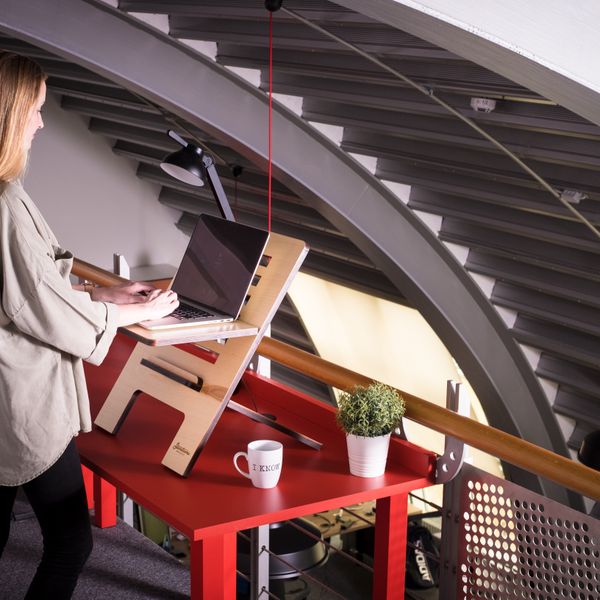
Rise Standing Desk Converter
Sit-stand, two-tier
Terra Anti-Fatigue Mat
Cushioned, bevelled edge
Desk height is only half the setup
Getting the surface right fixes your shoulders and wrists, but two more things sit on that desk and deserve the same care. The monitor should be an arm's length away (about 50–70 cm) with the top of the screen near eye level, so your neck stays neutral rather than tipped down. If a riser can't get the height or distance right — common with a chair you've raised, or with a very tall or ultrawide screen — a gas-spring monitor arm like the Arc Single Monitor Arm lets you set height, distance and tilt independently and frees the desk beneath it. The keyboard and mouse should sit at that same elbow height you established at the start, close enough that your upper arms stay relaxed at your sides rather than reaching forward. Keep your wrists straight and floating rather than cocked up or planted hard on the edge. Once the desk height is genuinely yours, these adjustments take minutes — and the whole setup starts working with your body instead of against it. This is general guidance, not medical advice; if you have persistent pain, see a qualified professional.

FAQ
What is the standard desk height, and is it right for me?
Fixed desks are typically 72–75 cm (about 28.5–29.5 inches). That suits someone around 180 cm tall and is slightly high for most people below that. Rather than trust the standard, do the elbow test: if your shoulders lift or your feet dangle, the desk is too tall for you and needs a chair-plus-footrest adjustment or an adjustable frame.
How do I know if my desk is too high or too low?
Sit with feet flat and forearms level. If your shoulders rise toward your ears or your wrists bend upward to reach the keys, the desk is too high. If you find yourself leaning or hunching forward and looking down at your hands, it's too low. When it's right, your upper arms hang relaxed, your forearms are roughly parallel to the floor, and your wrists stay straight.
Should I get a standing desk or just fix my seated height?
Get your seated height right first — it's free and solves most discomfort. Consider a standing desk if you want to vary your posture through the day, because sitting and standing need quite different heights that no single fixed desk can hit. An adjustable frame with memory presets, or a converter that sits on your current desk, lets you switch between your two ideal heights without re-measuring each time.
Is there a formula for ideal desk height?
For a rough standing height, multiply your height in cm by about 0.62 — so 175 cm gives roughly 108 cm. Seated heights are harder to formularise because chair and torso proportions vary, so use the by-height chart above as a starting point and then fine-tune with the elbow test. The measurement always beats the formula.